7 Advantages at a Glance
- Extreme durability — lasts 10–30 years with professional installation
- Near-zero maintenance — sweep and mop, no refinishing or waxing ever
- Stunning design options — metallic, flake, quartz, solid, and custom
- Built-in safety — slip resistance, fire resistance, light reflection
- Cost-effectiveness — 30–50% less than tile or hardwood over 15 years
- Universal versatility — works in any space with a concrete subfloor
- Healthier environment — seamless, non-toxic, hypoallergenic surface
1. Extreme Durability: 10–30 Year Lifespan
Professionally installed epoxy flooring lasts 10 to 30 years in residential settings and 5 to 20 years in high-traffic commercial environments. That's comparable to or better than tile, hardwood, and polished concrete — at a lower price point with less maintenance.
What makes epoxy so durable is its chemical composition. When resin and hardener mix, they form a rigid, cross-linked polymer that bonds molecularly to prepared concrete. The resulting surface withstands heavy foot traffic, vehicle weight, dropped tools, chemical spills, dragged furniture, pet claws, and daily wear that would destroy paint, stain, or thin sealers within months.
When wear eventually appears — typically after 10–15 years in high-traffic areas — the floor can be re-coated with a fresh topcoat rather than fully replaced. This is a major advantage over tile (which requires tearing out and re-laying) or hardwood (which needs complete sanding and refinishing). A re-coat takes one day and costs a fraction of the original installation. Learn about residential epoxy durability.
Ready to transform your space?
Get a free, no-obligation quote from your local Ascent Epoxy team.
Get a Free Quote2. Near-Zero Maintenance
Epoxy's seamless, non-porous surface makes maintenance almost effortless — and the time and money you save over the floor's lifetime is substantial.
The daily routine is simple: sweep or dust mop to remove grit and debris. That's it for most days. Periodically — once a week or as needed — mop with warm water and a mild pH-neutral cleaner. There's no grout scrubbing (like tile requires every few months), no refinishing (hardwood needs it every 5–7 years at $2–$4/sq ft), no waxing or buffing (like VCT commercial tile demands monthly), and no carpet cleaning or replacement.
Spills — even oil, wine, coffee, and paint — wipe up instantly because the surface is completely non-porous. Nothing penetrates. For garages, a quick hose-down removes tire marks, road salt, and winter grime in minutes. Compare that to bare concrete, which absorbs oil stains permanently and requires expensive chemical treatments to clean.
Over a 15-year period, the maintenance savings alone can approach the original installation cost. A tile floor of equivalent size requires $500–$1,000+ in grout cleaning and sealing over the same period. Hardwood requires $2,000–$4,000 in refinishing. Epoxy requires a broom and a mop.
3. Stunning Visual Options
Epoxy offers design possibilities no other flooring can match at this price point. While tile comes in fixed patterns and hardwood comes in wood tones, epoxy is limited only by imagination — and every installation is genuinely one-of-a-kind.
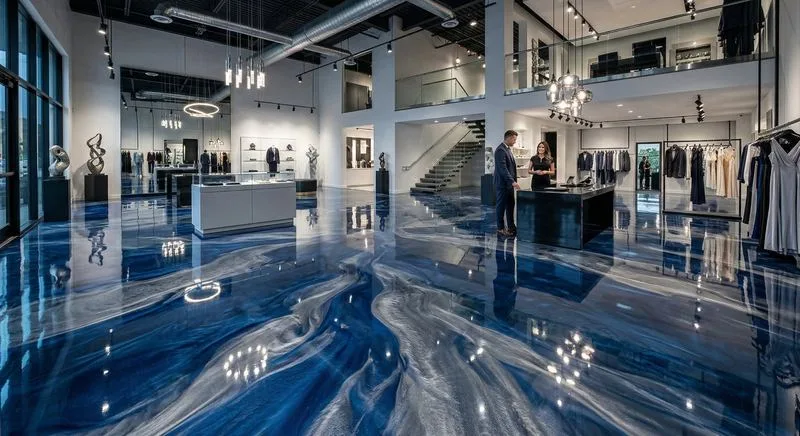
Metallic epoxy creates flowing, three-dimensional patterns that resemble polished marble, ocean waves, or liquid metal. The effect is achieved by manipulating metallic pigments during application — no two floors ever look alike. It's the premium choice for basements, showrooms, and anyone who wants a floor that stops visitors in their tracks.
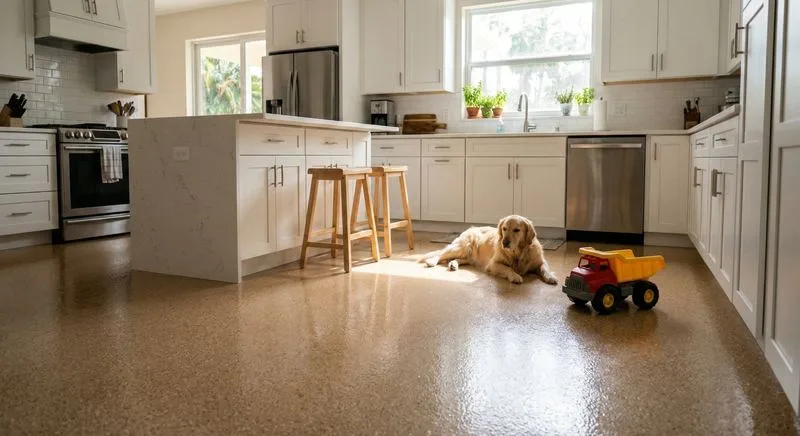
Decorative flake (also called chip) broadcasts colored vinyl chips into wet epoxy for a multi-toned, textured surface. It's the #1 choice for garages — the texture hides scuff marks and adds natural slip resistance, while the multi-color pattern looks great even with daily vehicle use.
Quartz broadcast uses colored quartz granules for a natural, stone-like elegance with exceptional grip. Solid colors deliver clean modern minimalism in virtually any shade. Custom designs enable company logos, color-zoned areas, geometric patterns, and branded flooring for businesses.
Browse all finish options with real project photos.
4. Built-In Safety Features
Textured finishes — particularly flake and quartz — provide significant slip resistance, even when wet. This makes epoxy ideal for garages (where water, oil, and snow melt create slippery conditions), kitchens (where spills are routine), commercial kitchens (where OSHA slip standards apply), and pool areas. Anti-slip additives like aluminum oxide or polymer beads can be mixed into the topcoat for even more grip, calibrated to the specific safety requirements of your space.
Beyond slip resistance, epoxy is inherently fire-resistant — it doesn't ignite or emit toxic fumes if exposed to heat, which matters in garages and industrial environments where flammable materials are stored nearby. The floor also won't support mold growth, making it a safer choice for basements prone to moisture.
High-gloss epoxy surfaces reflect ambient light, significantly improving visibility in garages, warehouses, and basements. Where bare concrete absorbs light and creates dim, shadowy spaces, epoxy bounces it back — reducing the need for additional lighting and making the space feel larger and more inviting.
5. Outstanding Cost-Effectiveness
At $3–$12 per square foot installed, epoxy flooring costs 30–50% less than tile or hardwood when you factor in both installation labor and long-term maintenance. The total cost of ownership over a 15-year period is the lowest of any professional flooring option for concrete subfloors.
Here's the math: A 500 sq ft garage floor with decorative flake epoxy costs roughly $2,500 installed. The same area in ceramic tile costs $5,000–$7,500 installed, plus $500–$1,000 in grout maintenance over 15 years. Hardwood (if applicable) costs $4,500–$7,500 plus $2,000–$4,000 in refinishing. Epoxy's 15-year total: $2,500. Tile's: $6,000–$8,500. Hardwood's: $6,500–$11,500.
Garage epoxy specifically has been shown to add $5,000–$10,000 to home resale value — meaning a $2,500 installation can deliver a 200–400% return when you sell. It's one of the highest-ROI home improvements available. See our complete pricing guide with breakdowns by project type.
6. Works Everywhere Concrete Exists
Epoxy adapts to virtually any space with a concrete subfloor, with each environment getting a system tailored to its specific demands:
- Garages — decorative flake for vehicle traffic, oil resistance, and easy cleaning
- Basements — metallic or solid color for moisture resistance and visual transformation
- Kitchens and bathrooms — quartz for slip resistance and seamless sanitation
- Home gyms — flake with anti-slip additives for dropped weights and heavy equipment. See our home gym guide
- Offices and retail — metallic or solid for brand-matching aesthetics and durability
- Restaurants and commercial kitchens — quartz with cove base for health code compliance. See our kitchen flooring guide
- Warehouses and factories — high-build systems with chemical resistance and safety markings
This versatility means one flooring system — with the same brand consistency, quality guarantee, and maintenance routine — can serve your entire property. Many commercial clients coat multiple spaces in a single project for volume pricing and uniform aesthetics.
Get a Free Quote for Your Floor
Our team provides detailed, no-obligation quotes within 24 hours — including prep, materials, and installation.
Get a Free Quote (954) 852-12637. Healthier Indoor Environment
Epoxy's seamless surface eliminates the grout lines, seams, joints, and crevices where bacteria, mold, allergens, and dust mites accumulate. In a tile floor, grout harbors millions of bacteria per square inch — even with regular cleaning. In carpet, dust mites and allergens embed deep in the fibers where vacuuming can't reach. Epoxy has none of these problems.
Once fully cured (7–10 days after installation), epoxy is completely non-toxic and hypoallergenic. It emits no VOCs, releases no particles, and is approved for use in healthcare facilities, schools, and food service environments where air quality and sanitation standards are strictest.
For families with allergies, asthma, or respiratory sensitivities, replacing carpet or old tile with epoxy can meaningfully improve indoor air quality. Pet owners also benefit — the seamless surface doesn't trap pet dander or odors, and accidents clean up with a single wipe instead of soaking into grout or carpet padding. Learn about residential epoxy for families.
3 Honest Things to Know Before You Commit
We believe in transparency — so here are three things we tell every customer before they commit. None are dealbreakers, but knowing them upfront helps you plan properly and set realistic expectations.
1. Professional Installation Is Non-Negotiable
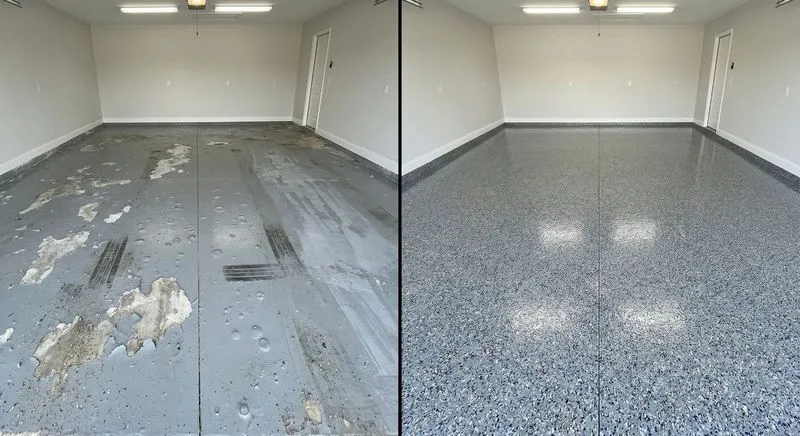
Epoxy's performance depends entirely on surface preparation and proper application. Our repair team sees the consequences of shortcuts on a weekly basis — peeling, bubbling, hot tire damage, and premature wear-through, almost always from DIY kits that skipped diamond grinding or used thin single-coat products.
Professional installation costs more upfront ($3–$12/sq ft vs. $0.50–$1/sq ft for a DIY kit), but the math is straightforward: one professional installation lasting 15+ years costs less than two or three failed DIY attempts plus professional remediation to fix them. The floor you get on day one is the floor you live with for decades — it's worth doing right. Read our full DIY vs. professional comparison.
2. Cure Time Requires Patience (3–7 Days)
After installation, you'll need to stay off the floor for 24 hours and keep vehicles off for 5–7 days while the epoxy reaches full chemical cure. For garage projects, this means arranging alternate parking (driveway, street, or a neighbor's garage) and clearing your schedule around the installation date.
We make this as easy as possible: during your consultation, we help you plan the timeline around your schedule, provide a specific cure calendar with milestone dates, and check in during the process to make sure everything is curing properly. It's a short inconvenience — typically one week — for a floor that lasts decades. See the full installation process and timeline.
3. Your Concrete Condition Matters
Epoxy bonds to concrete, not to other surfaces. Existing paint, sealers, tile adhesive, carpet glue, or old coatings must be completely removed before application — our diamond grinding process handles this, but it adds time and cost if extensive. Concrete with serious structural damage (large cracks, heaving, or settlement) or active moisture problems may need remediation before coating.
The good news: a professional consultation identifies all of these issues upfront, before you commit to anything. We inspect the concrete, test for moisture, assess any existing coatings, and provide a quote that accounts for every variable. There are no surprises — the scope and price are locked in before work begins. Get your free concrete assessment.
