Health Code Requirements for Kitchen Floors
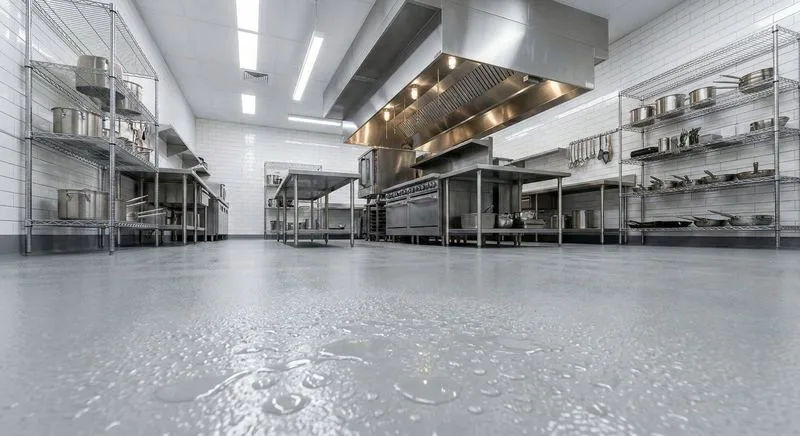
Commercial kitchen floors must meet health department standards that vary by jurisdiction but universally require four things: seamless, non-porous surfaces that prevent bacterial growth; textured enough to prevent slips but smooth enough to clean thoroughly; resistance to commercial sanitizers and cleaning chemicals; and proper integration with wall bases to prevent moisture intrusion at junctions.
Tile with grout — the traditional kitchen floor — fails on the first requirement. Grout lines are porous channels that harbor bacteria, grease, and moisture regardless of how aggressively they're cleaned. Health inspectors know this, and facilities with deteriorating grout face repeated citations. VCT (vinyl composition tile) has seams that separate over time, creating the same moisture-trapping problem. Bare concrete is porous and stains permanently.
Epoxy flooring satisfies every one of these requirements when properly specified and installed. The seamless, non-porous surface eliminates bacterial harborages. Quartz aggregate provides slip resistance that meets OSHA standards. Chemical-resistant topcoats withstand daily sanitizer exposure. And integral cove bases seal the wall-floor junction completely. It's why epoxy has become the standard for new commercial kitchen construction and the #1 renovation choice for existing kitchens. See our commercial flooring solutions.
Why Epoxy Is the #1 Choice for Commercial Kitchens
Epoxy creates a monolithic, seamless floor with zero joints, seams, or grout lines where bacteria, grease, and moisture can hide. In a commercial kitchen environment, this isn't just a convenience — it's the difference between passing and failing a health inspection.
Ready to transform your space?
Get a free, no-obligation quote from your local Ascent Epoxy team.
Get a Free QuoteThe coating withstands the thermal shock of boiling water and hot grease spills without cracking or delaminating. It resists the oils and animal fats that destroy VCT adhesive and stain concrete permanently. It handles the caustic cleaning agents required for food safety compliance — bleach, quaternary ammonia sanitizers, and industrial degreasers — without degradation. And it can be installed with integral cove bases that seal the wall-to-floor transition, eliminating the #1 bacterial harborage point inspectors flag.
A failed health inspection can cost a restaurant $5,000–$50,000 in fines, forced closures, and reputation damage. The right floor prevents this entirely — and pays for itself the first time it saves you from a citation. Epoxy flooring systems designed for food service environments meet USDA and FDA standards for surfaces in contact with food preparation areas.
Slip Resistance: The #1 Kitchen Safety Concern
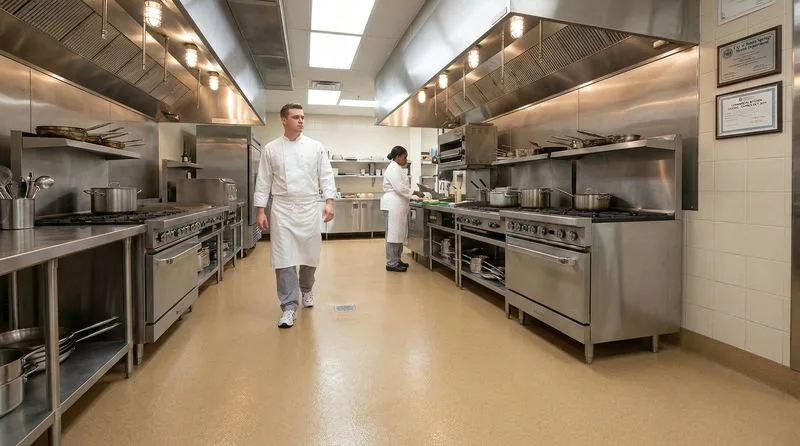
Kitchen slip-and-fall accidents are a leading cause of workplace injury in food service, costing the restaurant industry an estimated $2 billion annually in workers' compensation claims, medical expenses, and lost productivity. The floor surface is the single most controllable factor in preventing these injuries.
Quartz broadcast epoxy systems provide the highest slip resistance of any seamless flooring option. The quartz aggregate granules embedded in the surface create a textured profile that grips non-slip shoe soles even when the floor is wet with water, oil, or grease. The key specification to look for: a static coefficient of friction (SCOF) rating of 0.6 or higher, which meets OSHA and ADA requirements for wet environments. Our kitchen systems are rated at 0.6–0.8 SCOF depending on the aggregate size selected.
Anti-slip performance can be calibrated to the specific hazards in your kitchen. Higher-volume kitchens with more water on the floor (dishwashing areas, steam cooking zones) can receive coarser aggregate for maximum grip. Lower-traffic areas (dry storage, office adjacent to kitchen) can use finer aggregate for a smoother feel underfoot. We assess your specific layout and hazard zones during the facility evaluation.
Chemical & Thermal Resistance
Commercial kitchen floors encounter an extreme chemical environment daily: bleach at 200+ ppm concentration, quaternary ammonia sanitizers, phosphoric acid degreasers, citric acid from food prep, vinegar, hot water at 180°F+ from dishwashers, steam from cooking equipment, and animal fats and oils in constant contact with the surface.
Kitchen-grade epoxy systems use chemical-resistant formulations and topcoats specifically engineered for this environment. The topcoat creates an impermeable barrier that prevents any chemical from reaching the epoxy body coat or the concrete beneath. Where a tile floor's grout absorbs grease and bacteria despite cleaning, and where VCT seams separate under chemical exposure, epoxy's sealed surface simply wipes clean.
Thermal shock resistance is equally critical. When a pot of boiling water hits a cold tile floor, the thermal differential can crack the tile and destroy grout. When it hits epoxy, the coating flexes microscopically, absorbs the thermal shock, and returns to its original state. Hot grease spills — potentially the most damaging kitchen hazard — roll off the non-porous surface without penetrating or staining. See how professional kitchen epoxy is installed.
Cove Base: The Most Important Detail Most People Miss
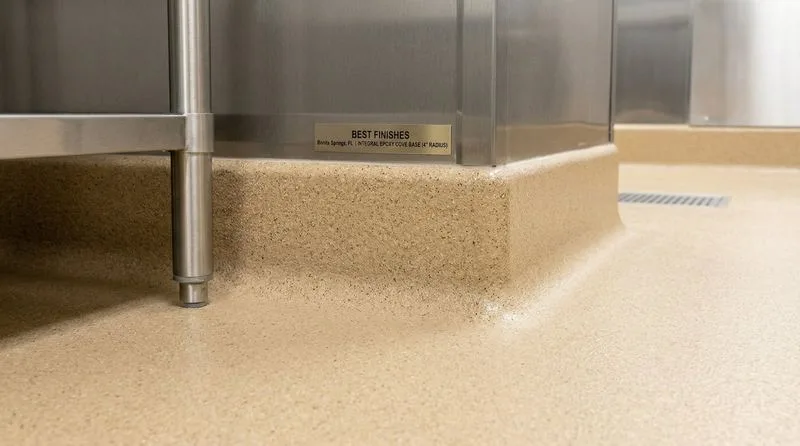
Health codes in virtually every jurisdiction require coved transitions between floor and wall in commercial food preparation areas. The cove base is a curved, seamless transition — typically a 4-inch radius — that eliminates the 90-degree corner where the floor meets the wall. That corner, in a tile or VCT installation, is impossible to clean thoroughly and becomes a permanent bacterial harborage point.
Epoxy cove base is formed by troweling a thick bead of the same epoxy material used on the floor up the wall to a height of 4–6 inches, then shaping it into a smooth radius curve. The result is a single, unbroken surface from floor to wall with no seam, no joint, and no gap. Water, grease, and cleaning chemicals flow off the floor, up the curve, and can be mopped away completely. Nothing gets trapped.
Compare this to alternatives: tile with grout cove base still has grout joints at the transition. Vinyl cove base is adhered with adhesive that eventually fails in wet environments, creating gaps behind the base where moisture and bacteria accumulate invisibly. Rubber cove base has the same adhesive failure problem. Only integral epoxy cove base creates a truly monolithic, seamless transition.
Get a Free Facility Assessment
We evaluate your kitchen floor, review health code requirements, and provide a detailed quote — no obligation.
Get a Free Quote (954) 852-1263Installation in Occupied Facilities
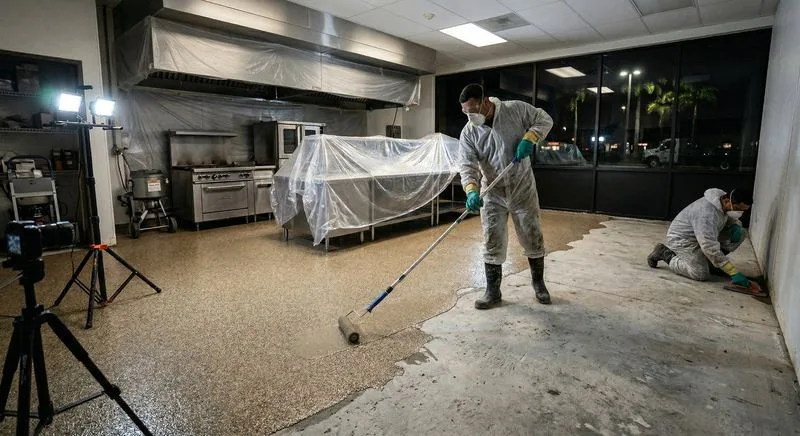
Commercial kitchen epoxy can be installed in phases during off-hours, keeping your kitchen operational throughout the project. We understand that closing a restaurant for a week isn't an option — every day closed is thousands in lost revenue.
Our phased installation approach divides the kitchen floor into zones (typically 2–4 sections depending on size and layout). Each zone is prepped, coated, and cured during a single overnight session or closed day. The next morning, that zone is walkable and the kitchen operates normally while the next zone is scheduled. A typical restaurant kitchen (400–600 sq ft) can be fully coated over 2–3 overnight sessions spanning one week, with zero days of closure.
For kitchens that operate 7 days a week with no closed days, we use fast-cure systems that achieve walkable hardness in 4–6 hours. A zone can be coated at midnight and walked on by the morning prep crew. Full chemical resistance develops over the following days, but light foot traffic and normal kitchen operations don't affect the cure.
Equipment protection is handled by the installation crew — stainless steel surfaces, cooking equipment, and walls are covered with plastic sheeting before any grinding or coating begins. We clean up completely before your staff arrives. The goal is simple: you lock up at night with an old floor and arrive in the morning to a new one. Learn about our phased commercial installation process.
Recommended Systems by Industry
Slip-resistant, chemical-resistant, health code compliant. Overnight phased installation. $6–$10/sq ft.
Hospital cafeterias, nursing home kitchens. Meets infection control standards. Seamless for gurney traffic. $8–$12/sq ft.
USDA/FDA compliant. Handles forklift traffic, thermal cycling, aggressive washdown chemicals. Pitched to drains. $8–$14/sq ft.
Handles acids, sugars, caustic CIP chemicals, and constant water exposure. Pitched floors with trench drains. $8–$12/sq ft.
Budget-friendly for large footprints. Handles high foot traffic and daily mopping. Summer installation during breaks. $5–$8/sq ft.
Cost & ROI for Kitchen Floors
Commercial kitchen epoxy runs $6–$10 per square foot for quartz systems with cove base — the standard specification for restaurant and food service environments. For a 500 sq ft kitchen, expect $3,000–$5,000 installed. Larger facilities (1,000–5,000 sq ft) benefit from volume pricing, typically $5–$8/sq ft.
The ROI calculation for kitchen floors is compelling because it stacks multiple savings simultaneously:
- Reduced cleaning labor. Seamless epoxy floors clean 30–40% faster than tile because there's no grout to scrub. For a restaurant that spends 45 minutes on floor cleaning nightly, epoxy saves 15–20 minutes per shift — roughly $2,000–$3,000 annually in labor costs.
- Fewer slip incidents. Reduced slip-and-fall claims lower workers' compensation premiums and avoid medical expenses. A single serious kitchen slip can cost $30,000–$50,000 in medical and legal expenses.
- Longer replacement cycles. Epoxy lasts 10–15 years in commercial kitchens. VCT needs replacement every 5–7 years. Tile grout needs re-grouting every 3–5 years. Over 15 years, epoxy's replacement advantage saves $10,000–$20,000 on a 500 sq ft kitchen.
- Health inspection compliance. Consistent passing grades avoid fines ($1,000–$10,000 per violation in most jurisdictions) and forced closures that can cost $5,000–$50,000 in lost revenue.
Most facilities see full payback within 18–24 months through maintenance savings and avoided incidents alone. See our complete commercial pricing guide. We also repair and re-coat existing kitchen floors.
Choosing the Right Kitchen System
For most commercial kitchens, we recommend a quartz broadcast system with chemical-resistant topcoat and integral cove base. This is the industry standard that satisfies every health code requirement while providing maximum durability and slip resistance.
The specific variables we dial in during your facility assessment:
- Quartz color and aggregate size. Warm sand and tan blends are most popular (they hide minor staining between cleanings). Aggregate size determines grip level — coarser for high-water areas, finer for service corridors.
- Topcoat chemistry. Standard chemical-resistant for most restaurants. Enhanced acid-resistant for facilities using aggressive cleaning protocols or handling acidic ingredients at scale.
- Cove base height. Standard 4" for most kitchens. 6" for high-volume dishwashing areas and facilities with aggressive washdown procedures.
- Drainage integration. Floors can be pitched to existing drains or new trench drains can be integrated during installation. Critical for breweries, food processing, and high-volume kitchens.
We bring physical samples to your facility so you can see and feel the quartz texture, compare color options against your stainless steel equipment, and understand exactly what the finished floor will look and feel like. Schedule your free facility assessment — we'll evaluate your floor, review your specific requirements, and provide a detailed quote.
See how our commercial floors hold up after years of daily use.
