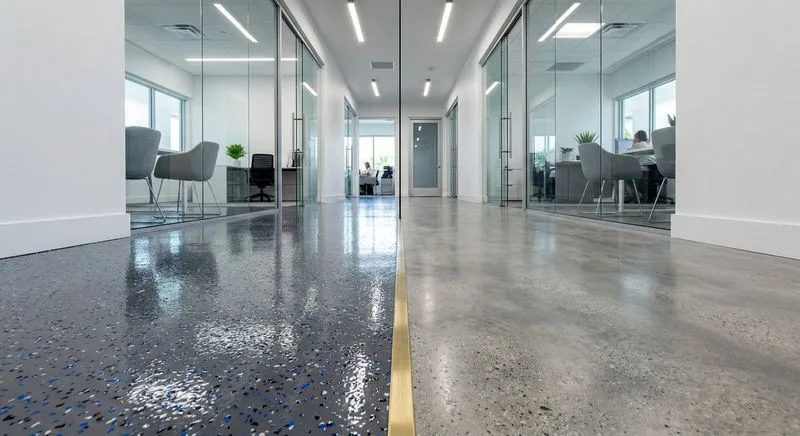
Side-by-Side Comparison
| Factor | Epoxy | Polished Concrete | Edge |
|---|---|---|---|
| Cost | $3–$12/sq ft | $3–$8/sq ft | Tie |
| Lifespan | 10–30 years | 15–25 years | Tie |
| Design Options | Unlimited colors, metallics, flake, custom | Natural gray tones, limited dye | Epoxy |
| Chemical Resistance | Excellent — all chemicals | Good — vulnerable to acids, oil | Epoxy |
| Maintenance | Sweep + mop only | Sweep + mop + periodic densifier | Epoxy |
| Stain Resistance | Non-porous, stain-proof | Microporous, stains possible | Epoxy |
| Renewability | Re-coat topcoat (1 day) | Re-grind entire slab | Epoxy |
| Natural Aesthetic | Coating over concrete | Reveals natural concrete beauty | Polished |
The Fundamental Difference
Epoxy and polished concrete both transform raw concrete into a finished, attractive floor — but they take fundamentally different approaches. Epoxy adds a multi-layer coating system on top of the concrete, creating an entirely new surface with its own color, texture, chemical resistance, and design. Polished concrete grinds and refines the existing slab to progressively finer smoothness until it achieves a reflective sheen — no coating is added.
This distinction matters because it determines everything else: design options, chemical resistance, repairability, and long-term maintenance. A coating (epoxy) can be customized, replaced, and repaired without touching the underlying concrete. A refined surface (polished concrete) is the concrete itself — beautiful in its natural state, but limited to what that concrete naturally looks like and harder to renew when worn.
Cost Comparison
Professional epoxy flooring costs $3–$12 per square foot depending on finish type, while polished concrete runs $3–$8 per square foot depending on the level of polish. For basic applications, the costs are comparable. Where they diverge is at the extremes and over time.
Ready to transform your space?
Get a free, no-obligation quote from your local Ascent Epoxy team.
Get a Free QuoteAt the entry level, a solid-color epoxy ($3–$5/sq ft) and a basic polished concrete ($3–$5/sq ft) are priced nearly identically. But decorative epoxy options — metallic ($8–$12), quartz ($6–$10), flake ($4–$7) — have no polished concrete equivalent. If you want anything beyond natural gray, epoxy is the only option that offers both variety and competitive pricing.
Long-term cost is where epoxy pulls ahead. When an epoxy floor eventually shows wear (typically after 10–15 years in high-traffic areas), it can be re-coated with a fresh topcoat — a one-day process costing roughly 25–35% of the original installation. When polished concrete wears, the entire slab must be re-ground from scratch — a multi-day process at nearly full original cost. Over a 25-year ownership period, one epoxy installation plus one re-coat typically costs less than two polished concrete grindings. See our complete epoxy pricing guide.
Durability & Lifespan
Both options last 15–25+ years with proper care, making them equivalent in raw lifespan. The difference is in what kinds of abuse they handle.
Epoxy creates a protective barrier between your concrete and the world. This barrier absorbs impacts (dropped tools, fallen equipment), resists abrasion (foot traffic, rolling loads), and shields the concrete from chemical penetration. If something damages the epoxy surface, the concrete underneath remains protected and the coating can be spot-repaired or re-coated.
Polished concrete IS the concrete — it's extremely hard (up to 1,800 PSI compressive strength) and handles heavy loads well. But because the polished surface is the concrete itself, any damage (chips, cracks, deep scratches) is permanent. Stains from oil, wine, or chemicals can penetrate the microscopically porous surface and become impossible to fully remove. In garages, hot tires can leave marks on polished concrete that are extremely difficult to clean, while epoxy's sealed surface wipes clean.
Winner for garages, kitchens, and industrial: Epoxy — superior chemical and stain protection. Winner for dry offices and low-chemical spaces: Tie — both perform excellently under normal foot traffic.
One additional factor: temperature. In unconditioned garages and warehouses, epoxy handles freeze-thaw cycling better than polished concrete, which can develop micro-cracking in extreme temperature swings. In climate-controlled interiors, this is not a factor.
Appearance & Design Options
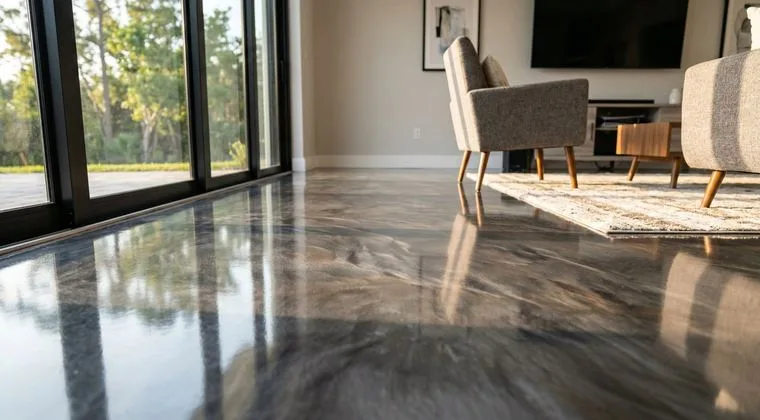
Epoxy offers unlimited design options including metallic, flake, quartz, solid color, and custom patterns, while polished concrete is limited to variations of natural gray concrete tones. This is the single biggest differentiator between the two and the primary reason most homeowners choose epoxy.
Polished concrete has a clean, minimalist, industrial-modern aesthetic. It's beautiful in its simplicity — natural concrete tones with occasional aggregate visible, refined to a mirror-like sheen. It can be dyed in earth tones (browns, tans, muted greens) but the color range is limited, the results are less predictable than epoxy, and dyed concrete fades faster than epoxy color.
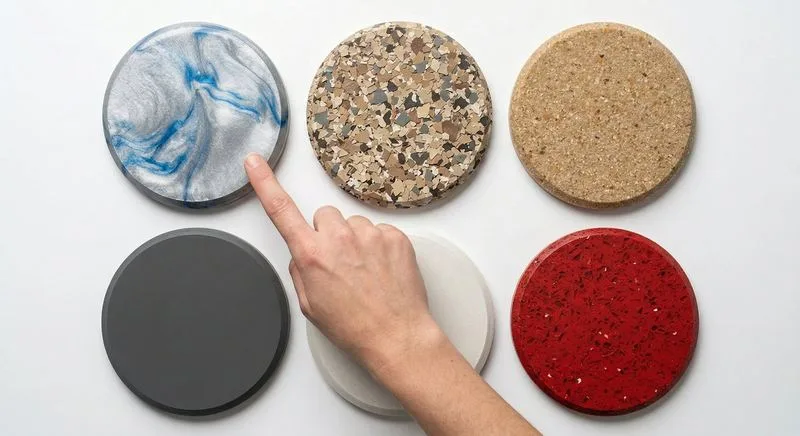
Epoxy, by contrast, offers five distinct finish categories — each with dozens of color options: metallic with flowing three-dimensional patterns, decorative flake with multi-toned texture, quartz with natural stone elegance, solid colors in virtually any shade, and custom designs including logos, borders, and branded zones. A homeowner who wants a blue-silver ocean-effect basement floor, a charcoal-flake garage, or a company logo embedded in their showroom floor can only achieve it with epoxy. See all epoxy finish options.
Winner for design variety: Epoxy — no contest. Winner for natural concrete look: Polished concrete — it IS the concrete, and that minimalist aesthetic can't be faked.
Maintenance
Both epoxy and polished concrete require only sweeping and occasional mopping for day-to-day care, making them two of the lowest-maintenance flooring options available. But there's a meaningful difference in long-term upkeep.
Epoxy's sealed, non-porous surface needs nothing beyond sweep-and-mop. Spills can't penetrate, stains can't form, and the topcoat protects the coating from UV degradation and abrasion. No waxing, no sealing, no periodic treatments. After a decade, the floor looks essentially the same as the day it was installed — assuming basic sweeping habits to prevent grit buildup.
Polished concrete sweeps and mops just as easily, but it benefits from periodic re-application of a densifier and guard product to maintain its sheen and stain resistance. Without these treatments (typically every 1–3 years depending on traffic), the polish gradually dulls and the surface becomes more vulnerable to staining. In food service environments, where grease and acidic ingredients are daily hazards, polished concrete requires significantly more maintenance attention than epoxy.
Winner: Epoxy — truly zero-maintenance beyond sweeping. Polished concrete is close but requires periodic product reapplication.
Get a Free Quote for Your Floor
Our team provides detailed, no-obligation quotes within 24 hours — including prep, materials, and installation.
Get a Free Quote (954) 852-1263Chemical & Stain Resistance
Epoxy's sealed, non-porous surface resists virtually all household and commercial chemicals — oil, gasoline, antifreeze, bleach, wine, coffee, solvents, and industrial cleaning agents. Nothing penetrates the coating. If you spill transmission fluid on an epoxy garage floor, you wipe it up and the surface looks exactly the same. This is why epoxy dominates in garages, commercial kitchens, and industrial environments.
Polished concrete resists most chemicals but has notable vulnerabilities. Acids — including vinegar, citrus juice, wine, and some commercial cleaning products — can etch the polished surface, leaving dull spots that require professional re-polishing. Prolonged oil contact (overnight drips from a parked car) can penetrate the microporous surface and create permanent dark stains. In a home kitchen where olive oil and lemon juice are daily occurrences, these vulnerabilities matter.
For any space where chemical exposure is routine — garages, kitchens, restaurants, medical facilities, auto shops, manufacturing floors — epoxy's chemical resistance is a decisive advantage.
Winner: Epoxy — significantly superior chemical and stain protection in every scenario.
Which Is Best for Your Space?
The right choice depends on three factors: what the space is used for, how much design customization you want, and what chemicals the floor will encounter.
Choose epoxy for:
- Garages — chemical resistance, hot tire performance, design options
- Basements — moisture resistance, design transformation, warmth underfoot
- Kitchens and bathrooms — slip resistance, seamless sanitation, stain-proof surface
- Commercial kitchens and restaurants — health code compliance, chemical resistance, cove base
- Retail showrooms — branded designs, metallic finishes, visual impact
- Industrial facilities — chemical resistance, safety markings, forklift-rated systems
Choose polished concrete for:
- Modern offices with minimal chemical exposure
- Retail spaces where the natural concrete aesthetic fits the brand
- Loft-style residential spaces embracing industrial design
- Spaces with strict budget constraints on a basic finish
Not sure which is right for your space? Get expert advice from our team — free, no obligation.
The Verdict
For most homeowners and businesses, epoxy delivers better all-around value. It wins on chemical resistance (non-porous vs. microporous), design options (unlimited vs. gray tones), renewability (re-coat vs. re-grind), and long-term maintenance (zero vs. periodic densifier). Polished concrete wins on natural aesthetic — if you love the look of refined concrete, nothing else replicates it.
Both outperform tile, hardwood, and carpet on concrete subfloors. Both last 15–25 years. Both are low-maintenance compared to alternatives. You can't go wrong with either — but if chemical exposure, design variety, or long-term cost matter to you, epoxy is the stronger choice.
Still not sure? The best way to decide is to see both options in person. Our team brings physical samples to every consultation and can walk you through the pros and cons for your specific space, lighting, and usage patterns — at no cost and no obligation.
